
We are living through a monumental, defining shift in the Out of Home (OOH) advertising landscape. For decades, the industry standard was relatively straightforward: find a high-traffic location, design a bold creative, and let the sheer scale of the billboard do the heavy lifting. Make no mistake, there will always be a place for brands executing incredibly bold, static takeovers, and that traditional approach still works perfectly for specific awareness-driven objectives.
However, we are noticing a massive shift this year. Clients are doing far less “standard OOH” and are instead prioritizing profound brand storytelling. They are looking to create fully immersive, experimental experiences for their customers that go far beyond a passing glance from a highway. They want to turn passive observers into active participants, cleverly integrating data collection and gamification right into the physical activation.
Out of Home has always been one of advertising’s most impactful channels, but today, fueled by dynamic digital creative, AI, and immersive technologies, it is undoubtedly its most innovative. Here is a look at how innovation is fundamentally transforming the medium across South Africa and the world, and why blending the physical with the digital is the ultimate frontier for capturing attention and delivering meaningful business results.
Breaking the Border: 2D Cut-Outs and Sculptural 3D Moulds
One of the most immediate ways to disrupt highway monotony is breaking out of the standard rectangular frame. For years, standard 2D cut-outs and perimeter extensions have provided a reliable visual pop. Today, structural engineering allows us to push far past flat extensions into fully dimensional, sculptural fabrication.
Using oversized 3D moulds fabricated from lightweight sculpted foam, reinforced fibreglass, and internal structural steel, physical products can literally lean out into real-world space:
- Kinetic Engineering: When Flying Fish challenged the industry to create a truly “flying” bottle, standard printing was off the table. The team engineered a 7-metre-long, custom-moulded replica of the bottle, airbrushed by hand to match glass reflections and fitted with an internal motorized drive. Mounted atop a prime highway gantry, the bottle physically rotated above passing commuters, turning a static roadside presence into a piece of kinetic architecture.
Spangles and Foils
Innovation does not always demand complex digital hardware or massive power draws. Some of the most striking visual disruptions come from clever physical materials that respond directly to the natural environment.
- Spangles and Reflective Kinetics: Spangles are individual, highly reflective discs treated with specialized mirrored coatings. Mounted in modular arrays across billboard faces, they require zero electrical power. Instead, ambient sunlight and changing wind currents set thousands of facets into synchronized motion, producing an eye-catching ripple effect that naturally triggers peripheral vision. They have been used to simulate kinetic water, shimmering luxury finishes, and explosive debris fields on action-movie takeovers.
- Holographic Foil Vinyls: On site where off-grid sustainability is prioritized, light-reactive holographic and metallic foils bring static vinyl to life. As vehicle headlights sweep across the face or the sun changes angle, the artwork subtly shifts in colour and intensity.
Roadside Theatrics: Live Interactive Installations
The roadside verge is prime territory for transforming an OOH site into live theater. By outfitting billboard structures with live operational elements, brands can generate authentic word-of-mouth momentum and cross-platform PR coverage.
- The Living Billboard: For Flying Fish along William Nicol Drive, the billboard face was transformed into an actual, functional living quarters. Two well-known comedians lived inside the billboard structure for 72 straight hours. Fitted with full living amenities, the activation hosted live on-site radio broadcasts with YFM, guest DJ appearances, and direct interactions with passing motorists, converting a standard commuter route into an ongoing live performance.
- Multi-Site Action Takeovers: For the premiere of Extraction 2, an entire network of roadside billboards was customized with bespoke stunt elements: dressed mannequins suspended from rigging, real smoke-generation canisters timed to traffic peaks, and integrated fire-effect LEDs that made the sites appear as active, burning action sets.
- Frequency-Triggered Street Dispensing: In pedestrian and captive roadside hubs, boards can house interactive mechanical systems. The Coke Studio Piazza installation featured a dual-mic karaoke system built into the media wrap. If two strangers matched vocal frequencies within target pitch bands, the unit automatically dispensed ice-cold beverages, using playful gamification to drive direct brand loyalty.
The “Phygital” Era: Web AR and Seamless Interactivity
The days of consumers simply looking at a billboard and moving on are fading. Today, the screen in the consumer’s pocket is the key to unlocking the screen on the street.
Web Augmented Reality (Web AR) is bridging this gap with zero friction. Historically, AR required consumers to download a cumbersome third-party app, which acted as a massive barrier to entry. Today, Web AR is accessed directly through a smartphone’s native web browser, meaning there is absolutely no app download required. This technology effortlessly transforms static OOH media, transit environments, and mall floor decals into highly interactive, 3D consumer touchpoints.
The true power of Web AR lies in its ability to facilitate an instant value exchange between the brand and the consumer—specifically through data collection. Before a user interacts with 3D content or plays an AR game, they are prompted to fill out a brief data capture form. In exchange for their basic details, they get to play, and ultimately, claim a reward.
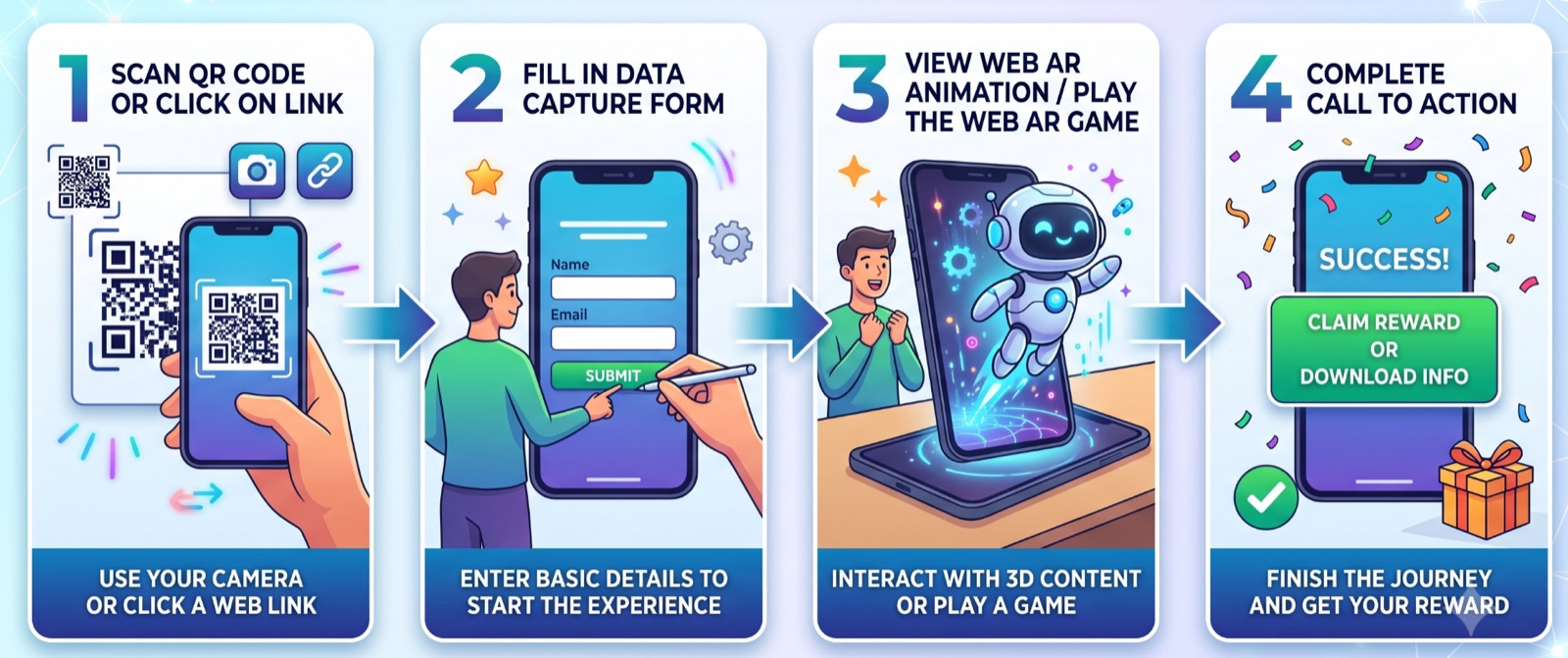
Consider the massive potential of these interactive, data-driven campaigns:
- Immersive Mall Gamification: Gamified floor decals placed in high-footfall mall zones act as digital portals. For example, scanning a Coca-Cola decal could open a virtual “Coke Studio” summer party, where users play a rhythm game by tapping ice cubes to a trending track. High scores instantly drop a digital voucher for a free beverage directly into their mobile wallet.
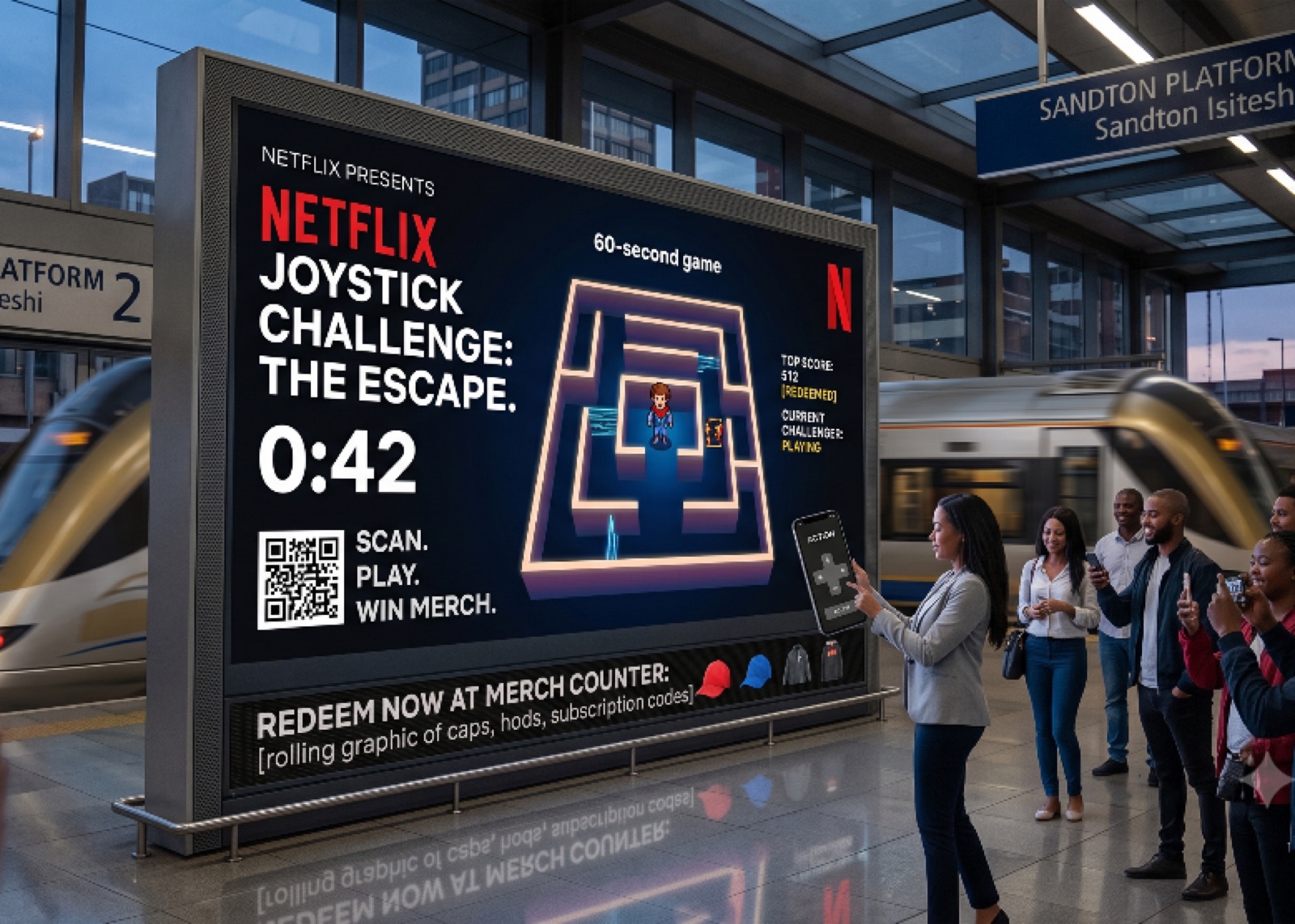
- Gamified Mobile-to-Screen OOH: Commuters waiting at a Gautrain station can scan a QR code to turn their smartphones into digital joysticks, allowing them to play a 60-second interactive maze game on a massive digital billboard to win merchandise or subscription codes.
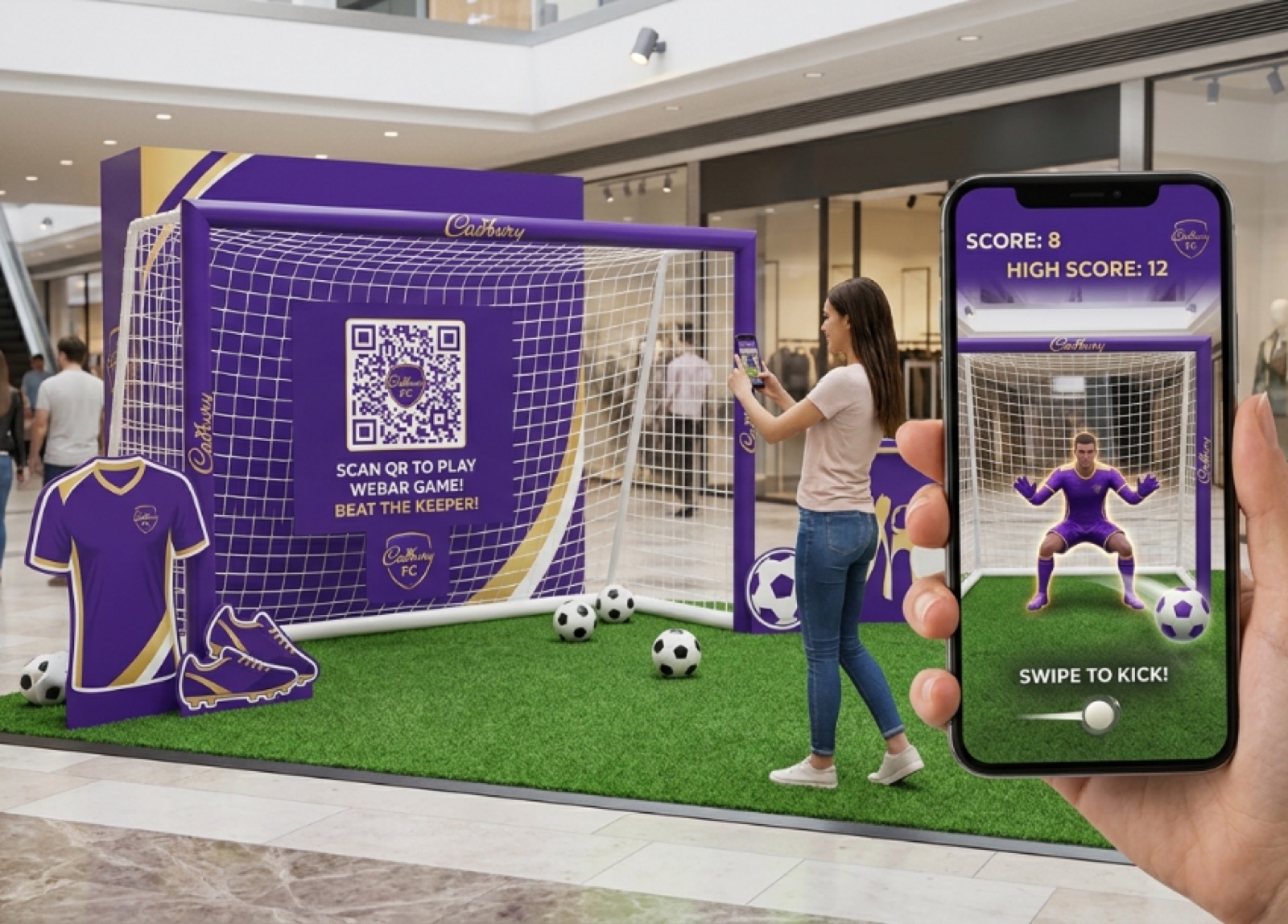
- Blending the Physical and Digital: The Cadbury FC “Beat the Keeper” concept perfectly illustrates ambient integration. A scaled-down physical football goal net is built in a mall space. When viewed through a phone, a fully animated digital goalkeeper appears to stand inside the real, physical net, challenging the user to swipe and kick a digital ball to win.
Multi-Sensory Immersion: Engaging Beyond Sight
If a picture is worth a thousand words, a multi-sensory brand experience leaves a memory that lasts a lifetime. The most innovative brands are now activating multiple senses simultaneously to tell deeper stories and forge emotional connections.
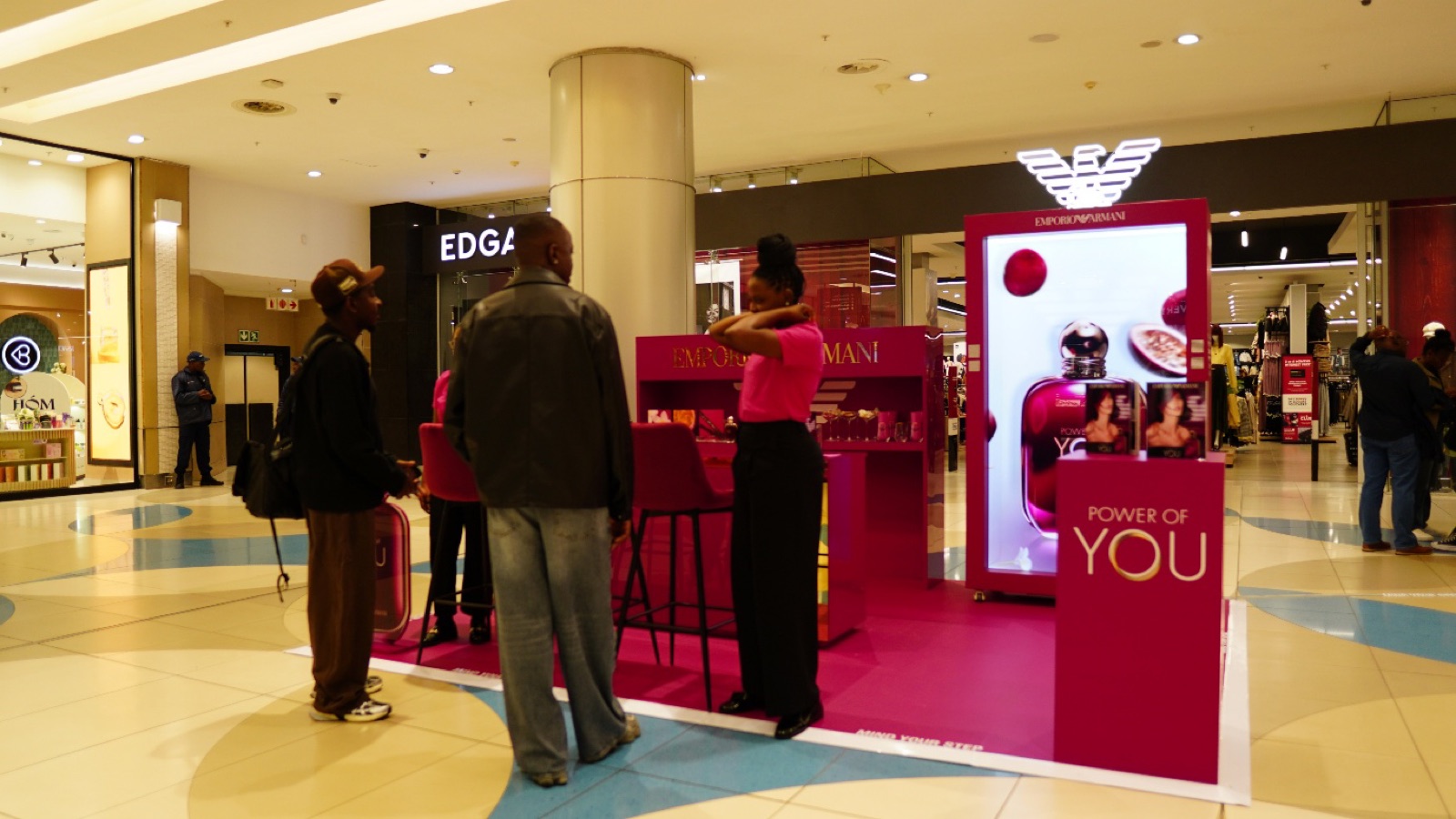
- Holobox Technology and Scent Marketing: Traditional product displays are being replaced by the Holobox—a 3D hologram box that displays spectacular, floating, looping 3D content. For the launch of the Armani Power of You fragrance, this custom 3D holographic visual was paired with advanced, integrated scent machines. The air in the mall was filled with the gorgeous aroma of the perfume as shoppers walked by, creating an irresistible draw.
- Full 360-Degree Environments: The Woolworths SA Christmas campaign took multi-sensory immersion to an unprecedented level. We helped bring to life a giant, traveling Biscuit Tin that journeyed across South Africa. The exterior was a stunning brand statement, but the interior was a fully immersive “cookie-world” journey. Guests experienced 360-degree projection-mapped walls, custom scent machines filling the space with a warm baked smell, and immersive audio perfectly synced with the visuals. Upon exiting, promoters handed out custom ice creams inspired by the biscuit theme, activating the final sense—taste.
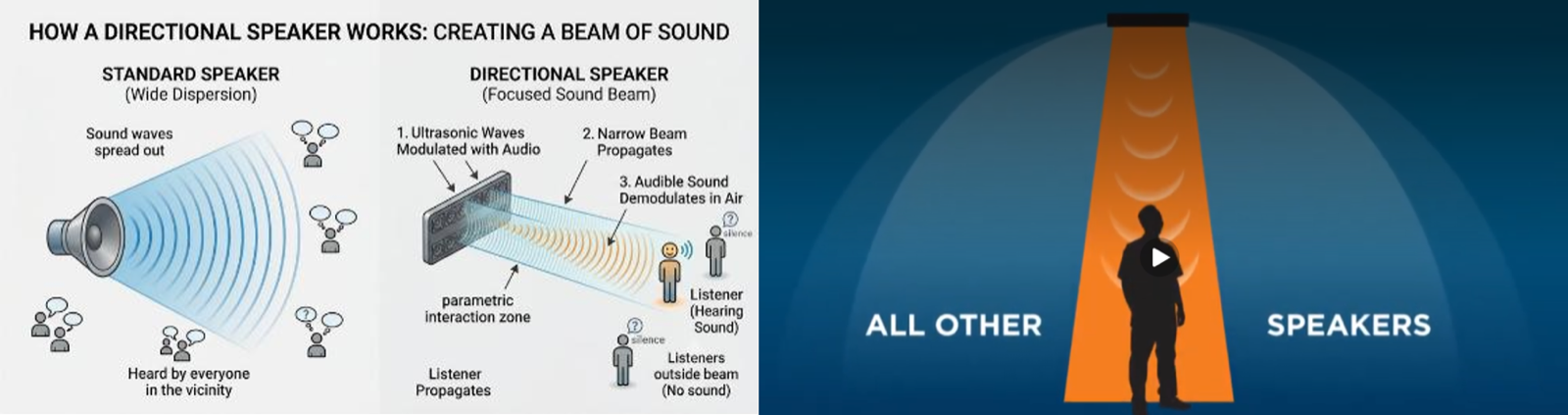
- Targeted Audio Integration: Sound in public spaces is usually chaotic, but new technology allows for precision. Directional speakers use ultrasonic waves to cleverly control multiple small sound sources, creating a narrow, highly focused beam of sound. This ensures that only the person standing directly in front of or underneath the speaker can hear the audio, making it a surprisingly powerful tool for tactical, intimate OOH activations.
Monumental Scale and Sky-High Ambition
Sometimes, telling a great story requires an entirely unconventional canvas. Innovation in OOH means breaking out of the standard 5x20 meter frame and looking at the environment itself as the medium.
- Geo-Advertising and Painted Grass: How do you reach an audience before they even touch the ground? By creating South Africa’s first-ever geo-advertising billboard for Hollard. This required engineering a staggering 4,000-square-meter reinforced PVC banner positioned specifically to target passengers looking out the windows of aircraft landing at OR Tambo International Airport. Weighing 2.3 tons and anchored by 1.5 tons of steel rebar, this wasn’t just a billboard; it became a landmark. Alternatively, brands can utilize non-toxic painted grass advertising, spraying a giant stencil of a product directly onto fields beneath flight paths for massive PR potential.
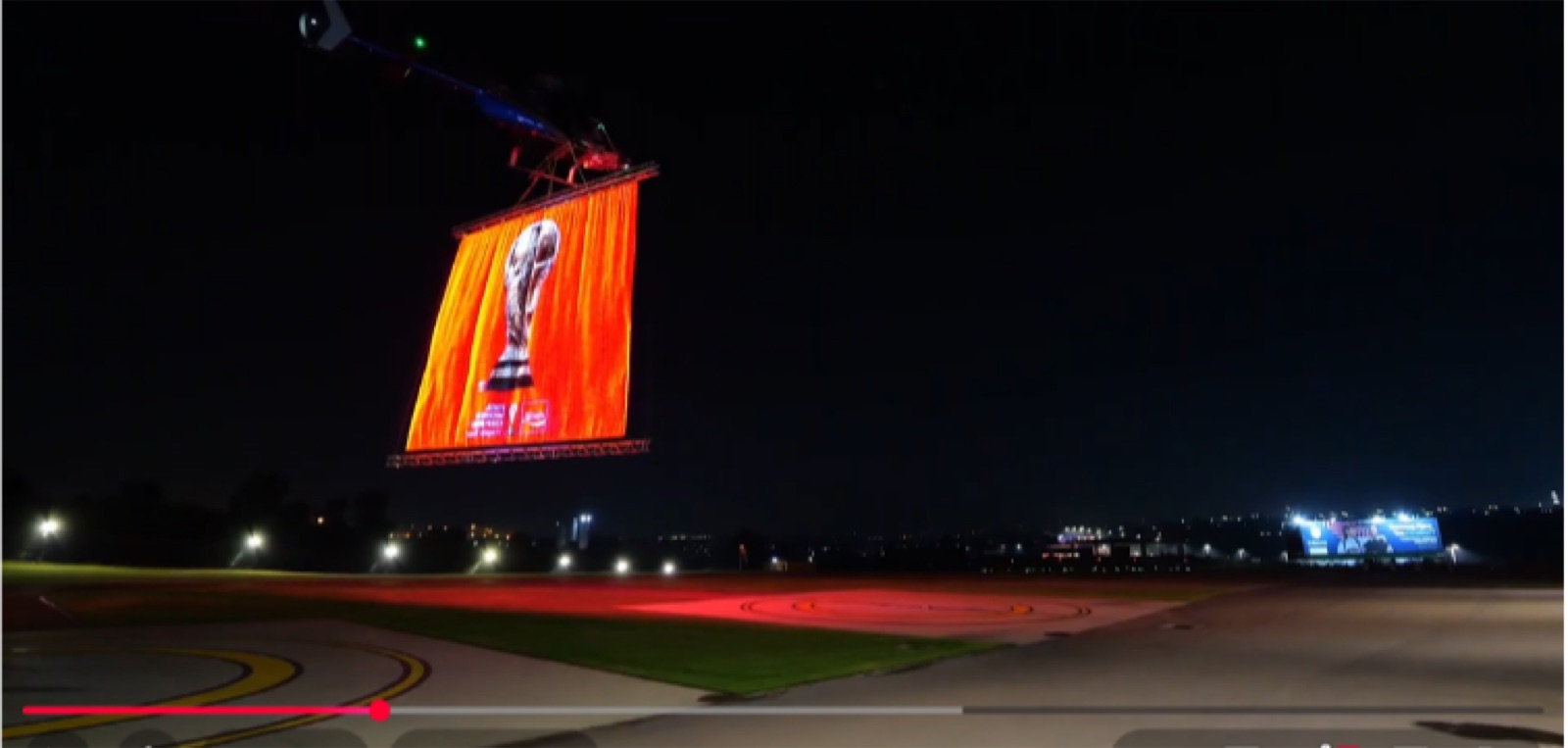
- Taking to the Skies: For the FIFA World Cup Trophy Tour for Coca-Cola, the brief was taken to the skies. A transparent, bright 10x8 meter LED mesh screen was lifted by a helicopter and flown alongside the N1 highway, lighting up the night sky. This execution became the second-largest flying digital screen in the world, turning the clouds into an illuminated canvas and delivering a true “look up” moment for thousands of commuters.
- Building Projections and Light Spectacles: Modern projection technology allows brands to map intricate, interactive stories onto buildings from up to 150 meters away. During the Telkom Hillbrow Tower New Year’s Eve celebration, the iconic tower was transformed into a 360-degree light spectacle using 12 high-powered Christie projectors, perfectly synchronized with debris-free, eco-friendly fireworks.
Blurring Reality: FOOH and AI Integration
Finally, the line between what is physical and what is digital is blurring entirely, creating campaigns that dominate both the real world and social media feeds simultaneously.
- Fake Out Of Home (FOOH): FOOH ads combine actual video footage of physical spaces with imaginative 3D elements, showcasing a product in an absurd yet hyper-realistic way. Whether it is a giant digital burger seemingly melting cheese off the side of a real building, or a colossal umbrella shielding a bridge, FOOH challenges everything we know about outdoor advertising and drives massive viral sharing online.
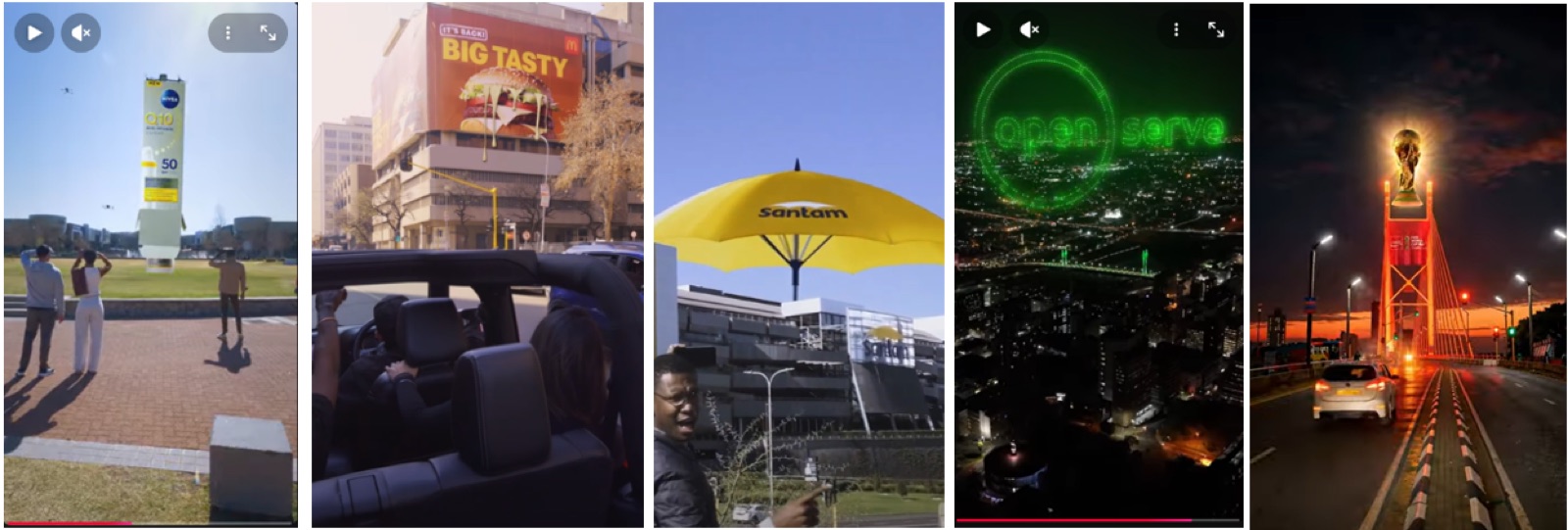
- Anamorphic 3D Digital: We can now design 3D screen adverts that are easily scalable across several digital screens. These optical illusions make products appear as though they are physically leaping out of the screen and into the shopping center, grabbing attention without the need for 3D glasses.
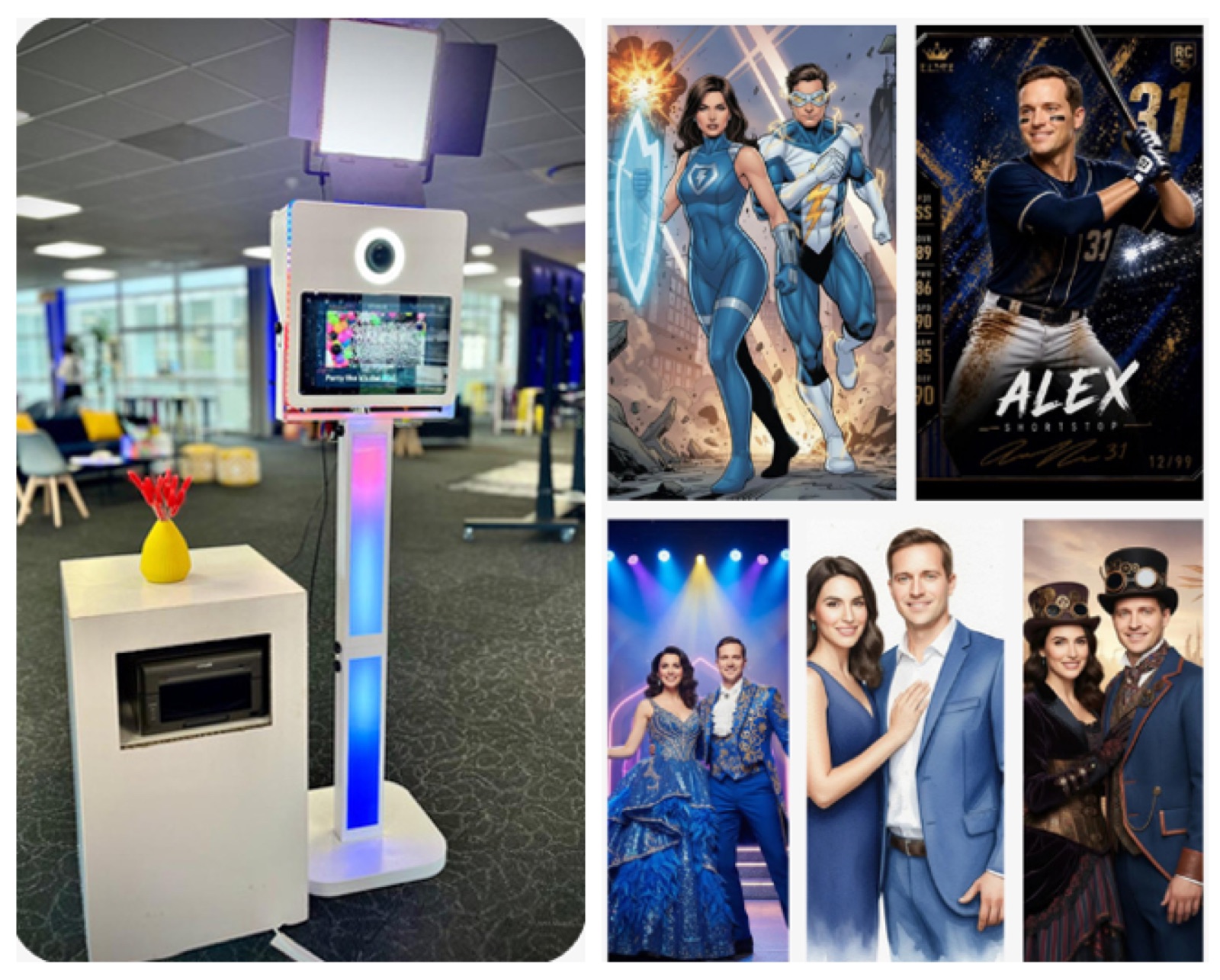
- AI Photo Stations: Activations are moving beyond standard photo booths. AI photo stations run advanced tech in the cloud, requiring no green screen or physical set build. Guests strike a pose, and within ten seconds, their identity is seamlessly switched into a superhero, astronaut, or Renaissance royal, chosen from over 170 prebuilt styles. The photos are printed instantly and highly optimized for digital sharing.
The Future is Now
Innovation in Out of Home is no longer just about tweaking print techniques or just adding pretty lights. True innovation is about creating memories.
Brands, agencies, and media owners who embrace these innovations will be best positioned to capture consumer attention in an increasingly distracted world. By prioritizing storytelling, rewarding interactivity, seamlessly integrating data collection, and pushing the boundaries of physical builds, the OOH industry isn’t just surviving the digital age, it is confidently leading it.