
Before I challenge programmatic DOOH, it’s worth saying this: I think it’s been a very important development in our industry in the last decade.
For an industry that has spent years trying to prove the effectiveness, accountability and agility of outdoor advertising, programmatic has been one of the most important developments we’ve seen. It has brought DOOH into mainstream media planning, made campaigns more flexible, improved accountability and, perhaps most importantly, made the channel far more accessible to agencies and advertisers who may never have considered it before.
That’s all good news.
Programmatic has democratised access to DOOH. It has not democratised expertise.
That distinction matters.
Access means more people can buy outdoor. Expertise means knowing which locations build brands, which environments create attention, and which screens are simply adding impressions without adding impact. Programmatic has solved the first challenge brilliantly. It hasn’t solved the second.
Which is precisely why I think it’s time we challenge one of the assumptions that has quietly crept in alongside its success.
Somewhere along the way we seem to have mistaken “available in a DSP” for “just another digital channel.” They’re not the same thing. Putting sushi in a lunchbox doesn’t make it a sandwich.
On the surface that sounds perfectly reasonable. After all, it sits inside the same DSPs, uses many of the same buying mechanics and often appears alongside display, online video and connected TV in the same campaign. It’s easy to see why the distinction has blurred. The problem is that the medium hasn’t changed just because the buying process has.
One of the unintended consequences of programmatic is that it hasn’t simply transformed how outdoor is bought; it has fundamentally changed who buys it. Increasingly, DOOH sits within digital teams, managed by specialists who understand audience data, optimisation, automation and platform mechanics better than ever before. That’s not a criticism. In fact, it’s an inevitable consequence of making the medium easier to access.
What concerns me is something slightly different. As an industry, we’ve quietly started confusing platform expertise with media expertise.
Knowing your way around DV360 doesn’t automatically make you an outdoor specialist, just as buying a very expensive set of golf clubs doesn’t automatically qualify you for the Masters. The tools matter, but they aren’t the craft.
Outdoor has always been a fundamentally different medium because people experience it differently. It exists in the physical world, competing with traffic, architecture, pedestrians, weather, shopfronts and the hundreds of distractions that make up everyday life. Unlike most digital channels, people aren’t actively seeking it out. It has to interrupt, surprise and earn attention in a fleeting moment, often with only a few seconds to do so.
That’s why great outdoor planning has always relied on questions that no DSP can answer. Is the billboard visible, or has nature quietly won the media planning battle? Is the creative legible at the speed people are travelling? Does the environment complement the message? Is this location building memory, or simply delivering impressions? Those are strategic decisions rooted in understanding human behaviour and physical context, not buying technology.
Yet because DOOH now lives inside digital buying platforms, there’s an increasing temptation to treat it like just another line on a media plan. The workflow is familiar, the optimisation tools are familiar and the dashboards certainly look familiar. Before long, we find ourselves applying digital logic to a medium that has always played by different rules.
Automation, of course, isn’t the villain here. Far from it. None of us should be nostalgic for manually trafficking campaigns, chasing insertion orders or spending days updating spreadsheets. Automation removes friction, and that’s exactly what it should do. The challenge is that automation has a habit of amplifying whatever sits behind it. Good planning becomes more efficient, but poor planning becomes more scalable. One poorly chosen screen bought manually is unfortunate; a hundred poorly chosen screens bought automatically quickly become a strategy.
The same is true when we think about inventory.
One of programmatic’s greatest strengths is the sheer amount of DOOH inventory now available. Thousands of screens can be accessed through a few clicks, giving planners more choice than ever before. The assumption seems to be that more choice naturally leads to better planning.
I’d argue the opposite.
The best planners I’ve worked with have never succeeded because they had the most options. They’ve succeeded because they knew which options to ignore.
We’ve all seen programmatic inventories containing screens tucked behind trees, hidden within visually cluttered retail environments or positioned in locations that simply don’t work for the objective at hand. Yet inside a DSP those screens appear every bit as available and every bit as legitimate as premium roadside assets or iconic retail locations. DSPs are wonderfully polite. They never judge inventory. They’ll present an iconic Sandton roadside spectacular and a forgotten screen behind a recycling bin with exactly the same enthusiasm.
It shouldn’t have to. That’s our job.
Which is why I believe one of the most exciting opportunities in programmatic DOOH isn’t opening up access to more inventory. It’s becoming far more intentional about the inventory we choose to make available in the first place.
For me, the future lies in curation.
Curated programmatic deals are, in many ways, the perfect balance between technology and expertise. They preserve everything that’s brilliant about automation: speed, flexibility, efficiency and optimisation, while reintroducing something that risks disappearing from the planning process: judgement.
Curated deals are the industry’s polite way of saying, “We’ve already removed the nonsense for you.” Instead of buying thousands of interchangeable screens, we’re buying premium commuter environments, financial districts, airport terminals, luxury retail precincts, university campuses or high-dwell lifestyle destinations. In other words, we’re not buying inventory, we’re buying context.
That’s a subtle distinction, but an important one.
Algorithms are incredibly good at optimising within boundaries. They are far less capable of deciding where those boundaries should exist in the first place. Someone still has to determine which screens belong together, which locations create attention, which environments reinforce the brand and, just as importantly, which inventory doesn’t deserve to be there at all.
Perhaps that’s the next evolution of programmatic DOOH.
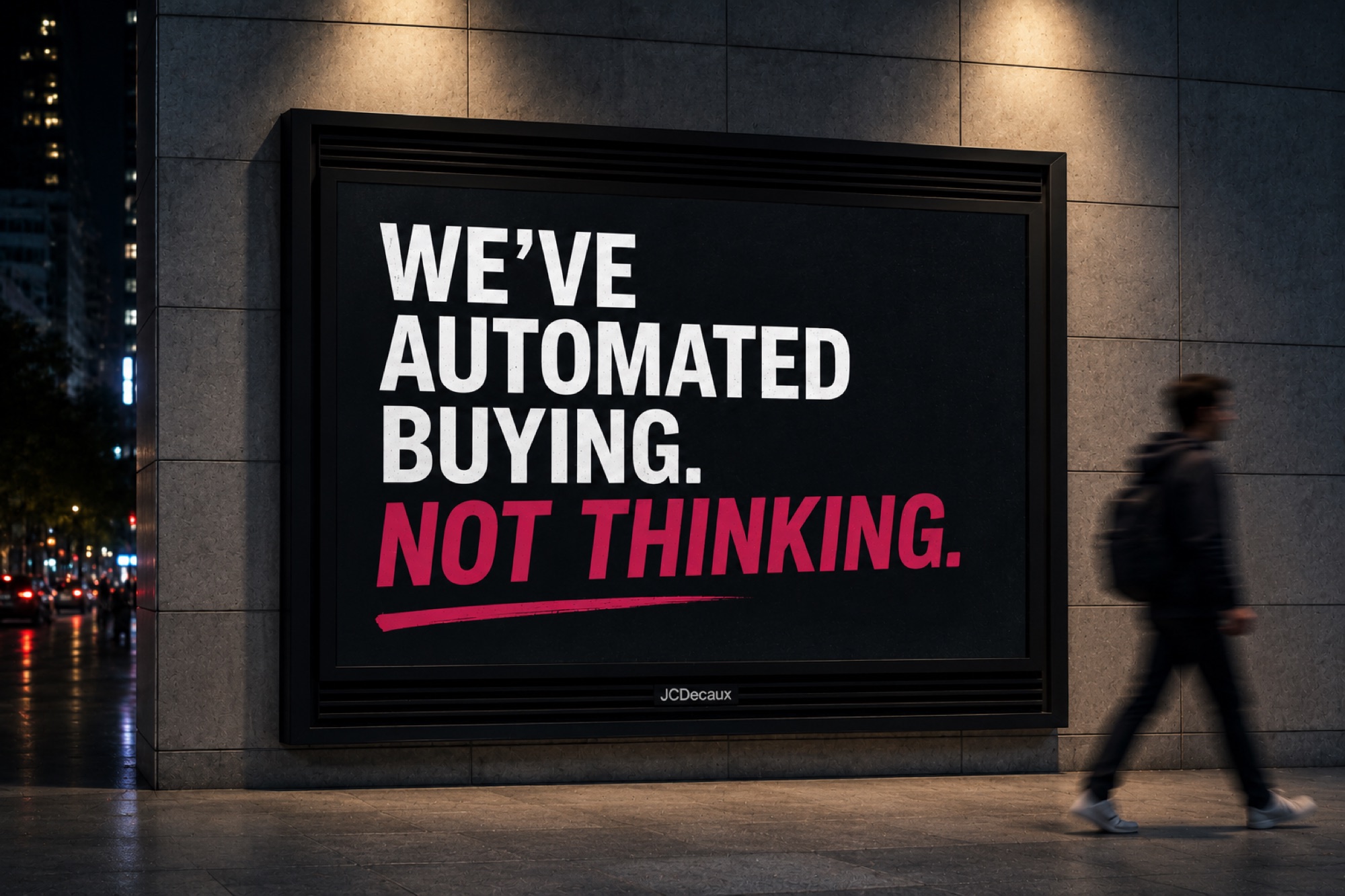
The first chapter was about proving that automation could transform how we buy outdoor. The second should be about proving that technology doesn’t remove the need for expertise, it increases it.
After all, every agency has access to the same DSPs, access to the same audience data, the same optimisation algorithms and increasingly the same AI capabilities. Technology has a habit of becoming commoditised. Judgement doesn’t.
In a world where execution is becoming easier every year, the competitive advantage shifts somewhere else entirely. It shifts towards the people who understand the medium deeply enough to know when to trust the algorithm, when to challenge it and, occasionally, when to ignore it altogether.
So perhaps the question facing our industry isn’t how we make programmatic DOOH even easier to buy. Perhaps it’s how we make it harder to buy badly.
Because if programmatic has taught us anything, it’s that technology can automate execution remarkably well.
Thinking, thankfully, is still up to us.